 Blog · Pitch deck series · Week 1 of 4
What is a pitch deck?
A practical guide to pitch decks, investor pitch decks and startup pitch decks, and how each one tells a different part of the same story.
A pitch deck is a concise, visual presentation used to communicate a business idea, opportunity or company story to a specific audience. But not every pitch deck serves exactly the same purpose.
An investor pitch deck, for example, focuses on the information potential investors need to understand a business opportunity. A startup pitch deck brings the wider story of an early-stage company together, from the problem it is solving to its market, business model and progress.
In this guide, we’ll explain what a pitch deck is, how it differs from a standard presentation, what investors typically expect from a pitch deck, and how those elements come together in a startup presentation.
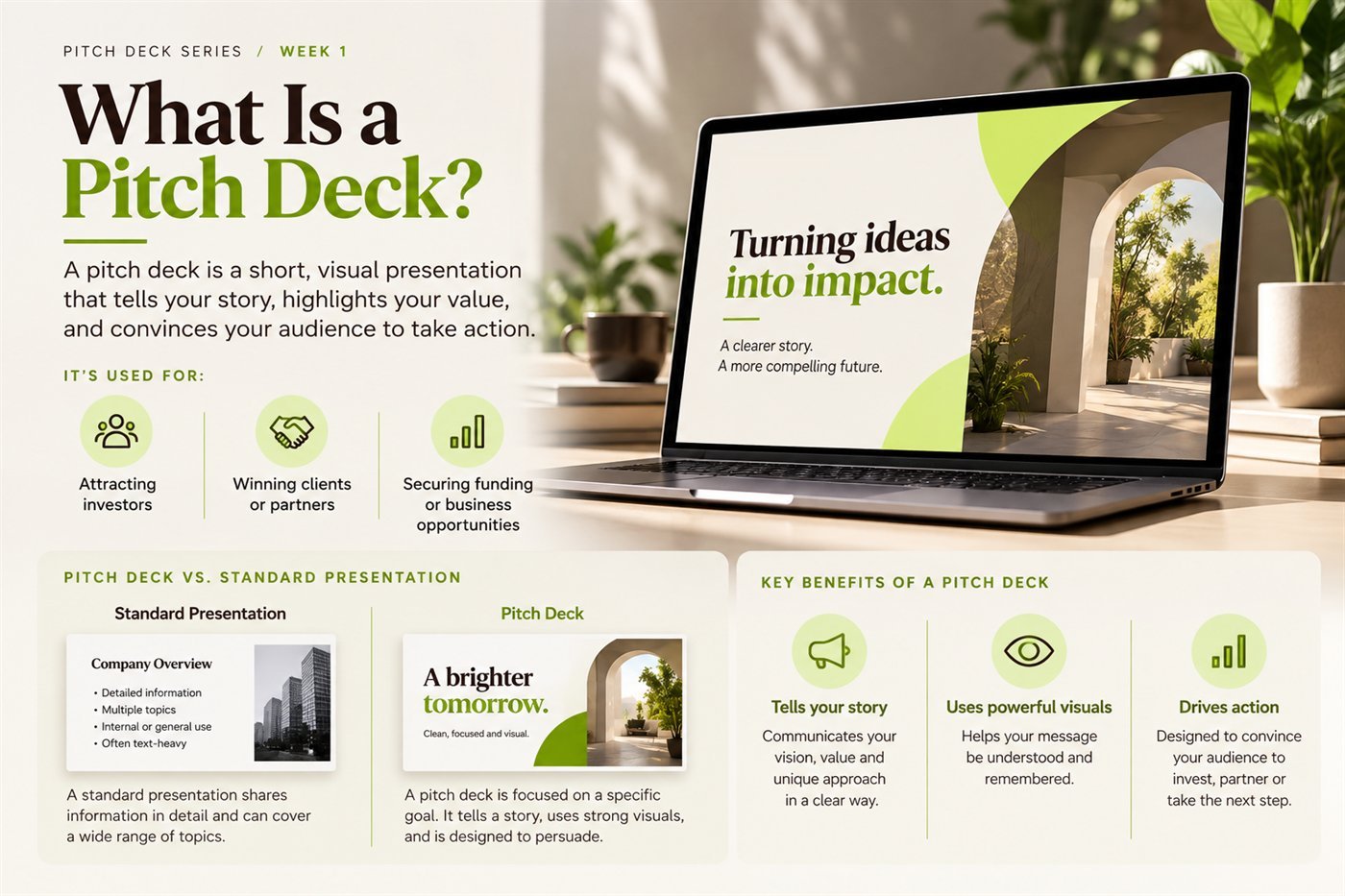
1. What is a pitch deck?
A pitch deck is a short, focused presentation designed to explain a business, idea or opportunity clearly and persuasively.
Rather than trying to communicate everything about a company, a good pitch deck presentation identifies the information that matters most to its audience and turns it into a clear, easy-to-follow story.
Pitch decks can be used in several situations. A startup may create a pitch deck for investors when raising funding. An established business might use one to introduce an opportunity to potential clients or partners. A company may also use a pitch deck when presenting a new product, service or business idea.
How is a pitch deck different from a standard presentation?
The biggest difference is usually purpose and focus.
A standard business presentation may primarily be designed to communicate information. A pitch deck usually has a more specific objective: establish a problem or opportunity, introduce an idea or solution, demonstrate why it matters and move the audience towards a next step.
That is why both storytelling and pitch deck design matter. Each slide should have a reason to exist. Instead of presenting disconnected information, the slides should work together so the audience can understand how the argument develops from beginning to end.
In simple terms: a pitch deck turns the most important parts of an idea or business into a focused visual story.
2. What is an investor pitch deck?
An investor pitch deck is a pitch deck created specifically to communicate a business opportunity to potential investors.
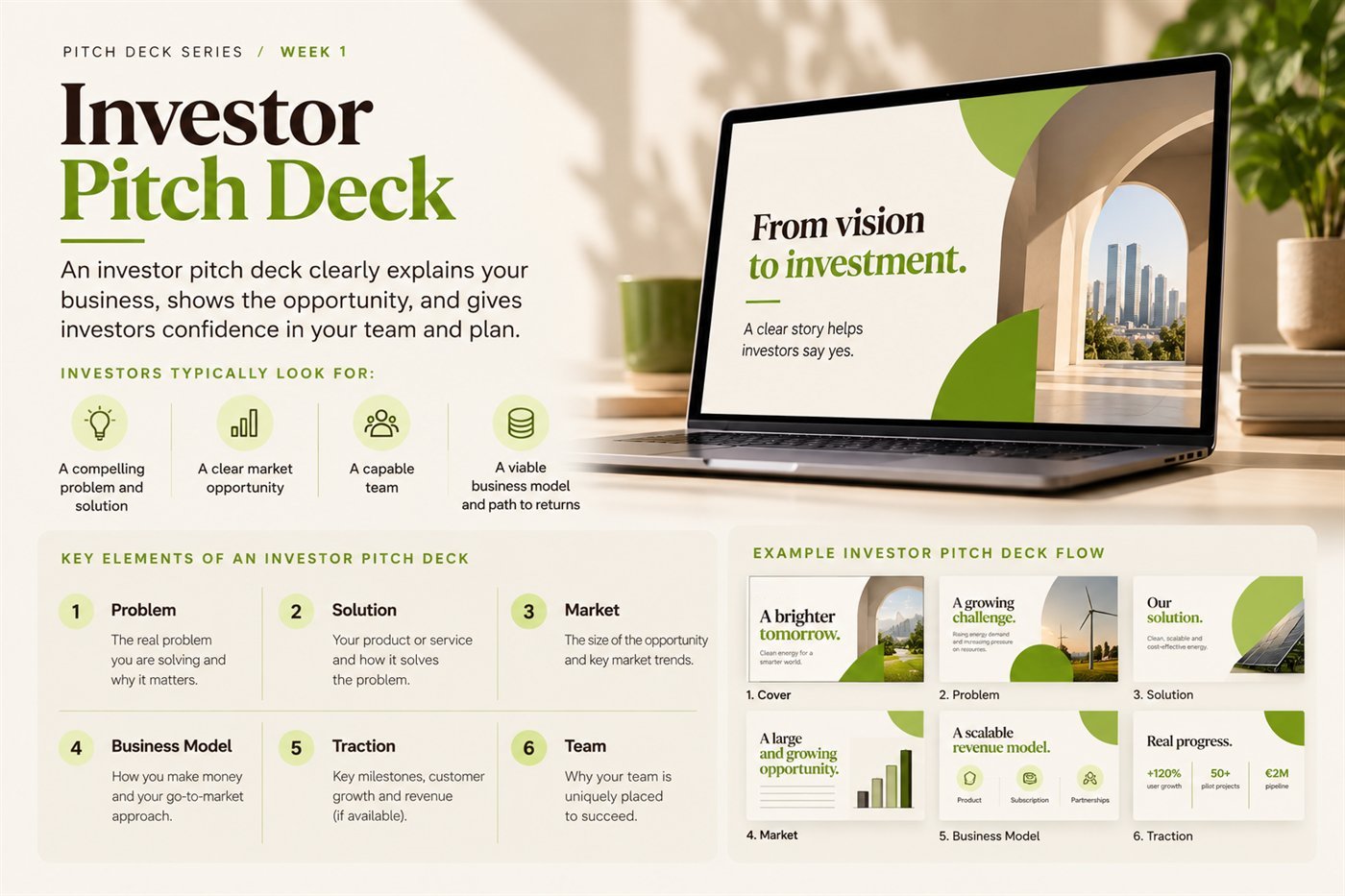
Because the audience is different, the emphasis of the presentation changes too. Investors need enough relevant information to understand the problem being addressed, the proposed solution, the market opportunity and how the business intends to create value.
The presentation should make it relatively easy to understand both the business and the reasoning behind the opportunity.
What should an investor pitch deck include?
Depending on the company, industry and stage of development, an investor pitch deck may include:
- Problem — What problem or unmet need exists?
- Solution — How does the company address it?
- Product or service — What exactly is being offered?
- Market opportunity — Who are the potential customers and what is the opportunity?
- Business model — How does the company intend to make money?
- Traction — What evidence of progress exists?
- Competition — What alternatives exist and how is the company positioned?
- Team — Who is building the business?
- Financial information — What projections help explain the business?
- The ask — What funding is being sought and how will it be used?
Simply including these slides does not automatically create an effective fundraising pitch deck. The information needs to work together.
For example, describing a large market is less useful without explaining the problem within that market. A strong product needs context around who needs it and why. Traction can add credibility by showing evidence of progress rather than relying entirely on future expectations.
A strong investor pitch deck therefore guides the audience through the business case rather than presenting a collection of disconnected facts.
In simple terms: an investor pitch deck helps answer three central questions — what is the opportunity, what evidence supports it, and what is the company asking for?
3. What is a startup pitch deck?
A startup pitch deck brings the story of an early-stage business together in a concise, structured presentation.
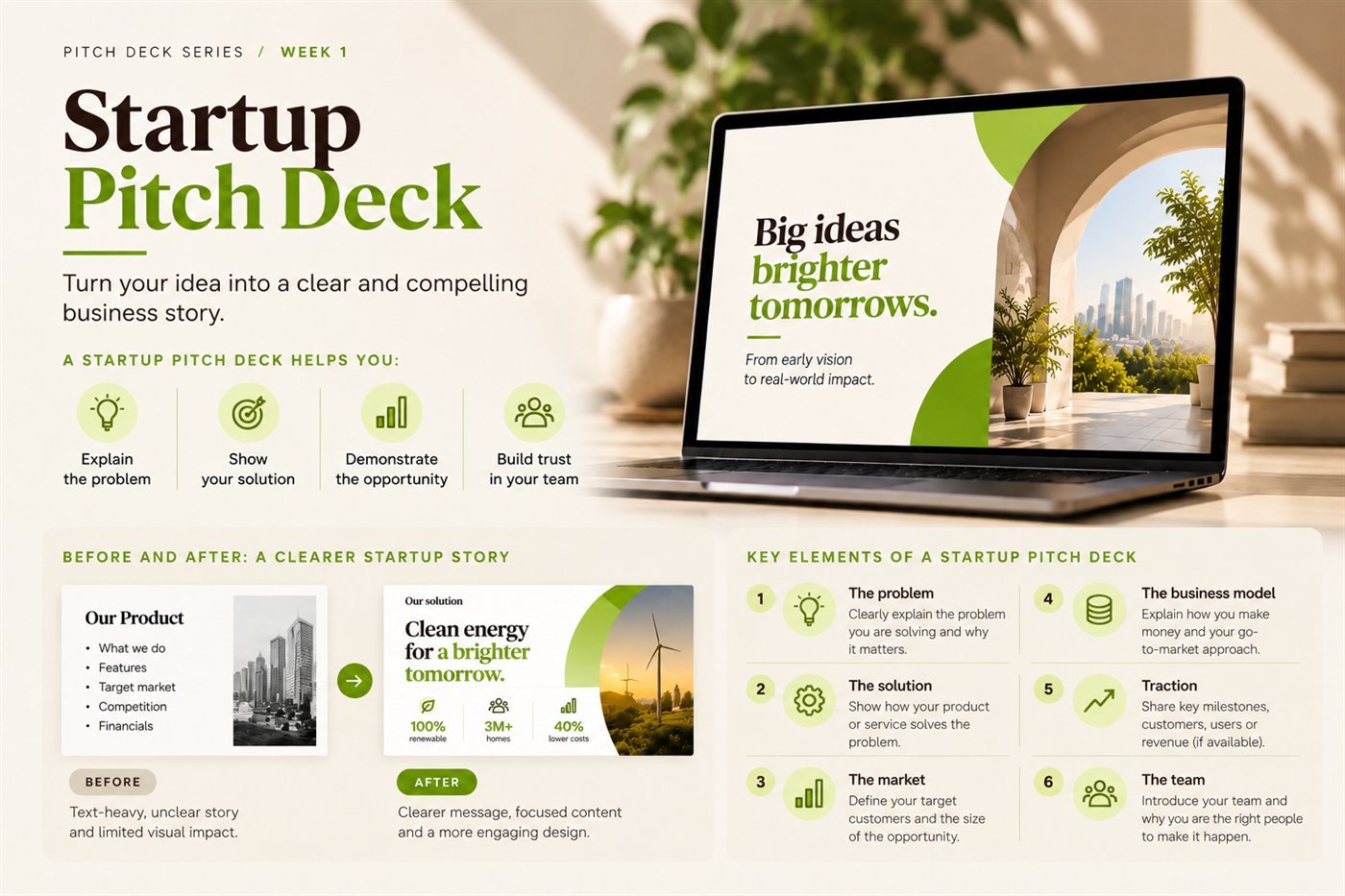
It often starts with a problem worth solving. From there, the deck introduces the startup’s solution and explains how its product or service addresses that problem.
But a good startup pitch deck presentation needs to go beyond the idea itself. Who is the target customer? What is the market opportunity? How could the company make money? What alternatives already exist? What has the startup achieved so far?
This is where elements such as the market, business model, competition and traction become important.
Traction will not look the same for every startup. Depending on the stage of the business, relevant evidence could include customers, users, revenue, pilots, partnerships or other meaningful milestones. The important point is not simply to fill a slide labelled “Traction” — any evidence included should help the audience understand the startup’s progress.
The deck should also introduce the team behind the company and make the next step clear. If the startup is raising investment, for example, the funding request should connect logically to what the business intends to achieve next.
In simple terms: a startup pitch deck turns an early-stage business into a structured story — problem → solution → opportunity → evidence → next step.
Investor vs. startup pitch deck
The terms investor pitch deck and startup pitch deck are often used interchangeably, and there is significant overlap between them — but they describe slightly different things.
“What is the business, and where is it going?”
“What does an investor need to understand about this business and the opportunity?”
A startup pitch deck describes the business and its story. It can potentially be used with investors, accelerators, partners or other audiences. An investor pitch deck is defined more specifically by its audience and purpose — it shapes the business story around the information relevant to a potential investment discussion.
A startup raising capital may therefore use an investor pitch deck — and the same presentation may also be described as its startup pitch deck. The distinction is less about choosing the “correct” label and more about understanding the audience.
From understanding to building
- Understand the formatA concise presentation that turns the most important information into a focused visual story.
- Understand the audienceAn investor pitch deck needs to make the business opportunity understandable from an investor’s perspective.
- Build the startup storyBring the problem, solution, market, business model, traction and next steps together into one coherent narrative.
How to make a pitch deck
Covering pitch deck structure and the most common pitch deck mistakes — turning these foundations into an effective deck.
Frequently asked questions
What is a pitch deck?
A pitch deck is a concise, visual presentation used to communicate a business, idea or opportunity to a specific audience, such as investors, clients or partners.
What is an investor pitch deck?
An investor pitch deck is a pitch deck created specifically for potential investors. It focuses on the problem, solution, market opportunity, business model, traction, team and funding request.
What is a startup pitch deck?
A startup pitch deck brings the story of an early-stage company together, covering the problem, solution, market, business model, traction and next steps.
What is the difference between a startup pitch deck and an investor pitch deck?
A startup pitch deck describes the business and its story more broadly. An investor pitch deck shapes that same story specifically around what a potential investor needs to know.
Knowing what goes into a pitch deck is the first step; making the slides carry the argument is the second. As a pitch deck design agency we have built investor, startup and client decks since 2003, in as little as two hours. Not sure where yours stands? Send up to ten slides for a free audit.
This is a PixelFaerie guide based on our perspective and experience.
Got a pitch deck that needs to land?
Send up to 10 slides for a free audit and get honest notes back from a designer, or talk to us about the whole deck.